

Custom Materials for Everyday Use
Built-in cabinetry · Wall panels · Fireplace surrounds · Surfaces · Lighting

Living Room Structural Redesign
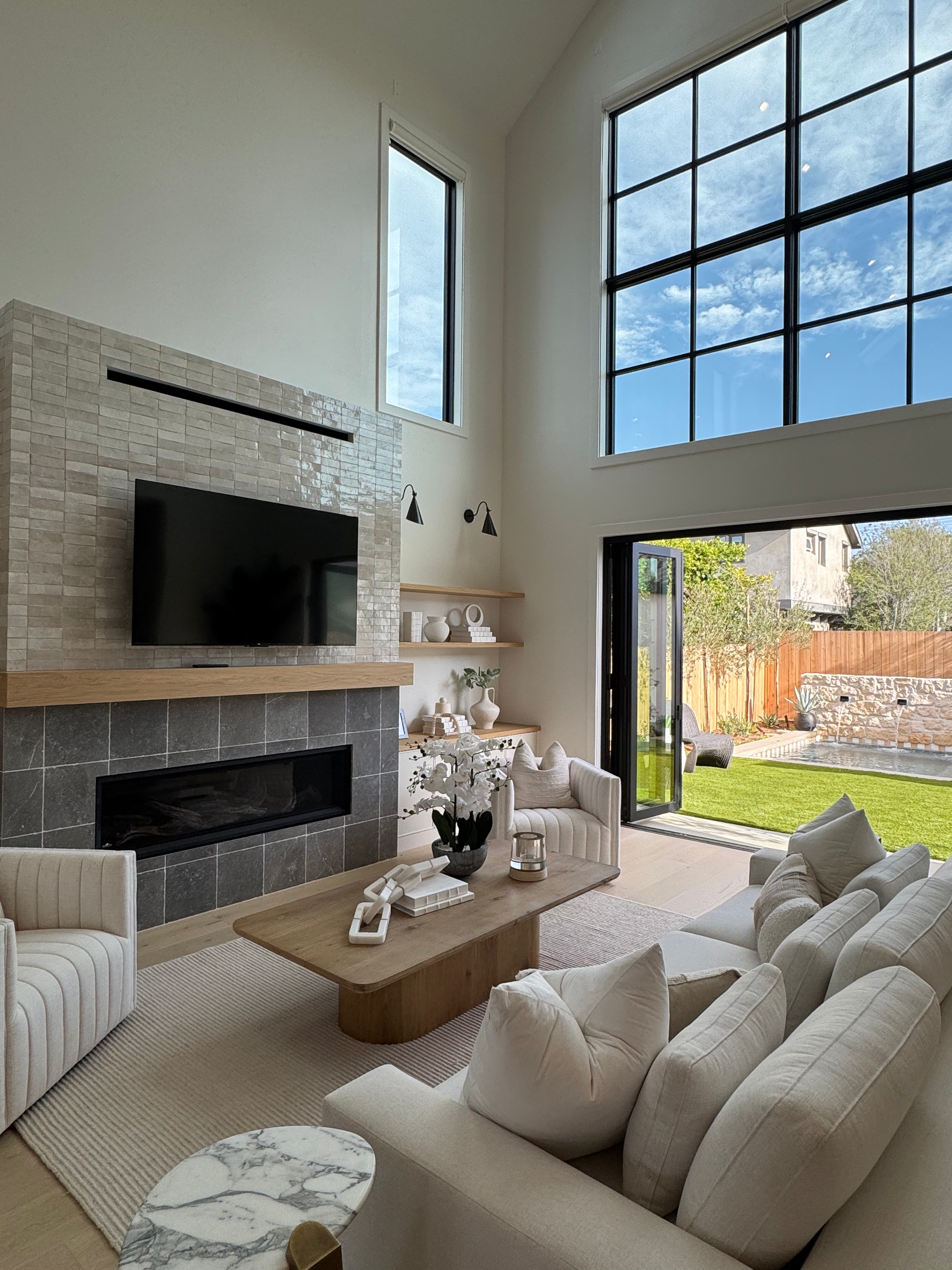
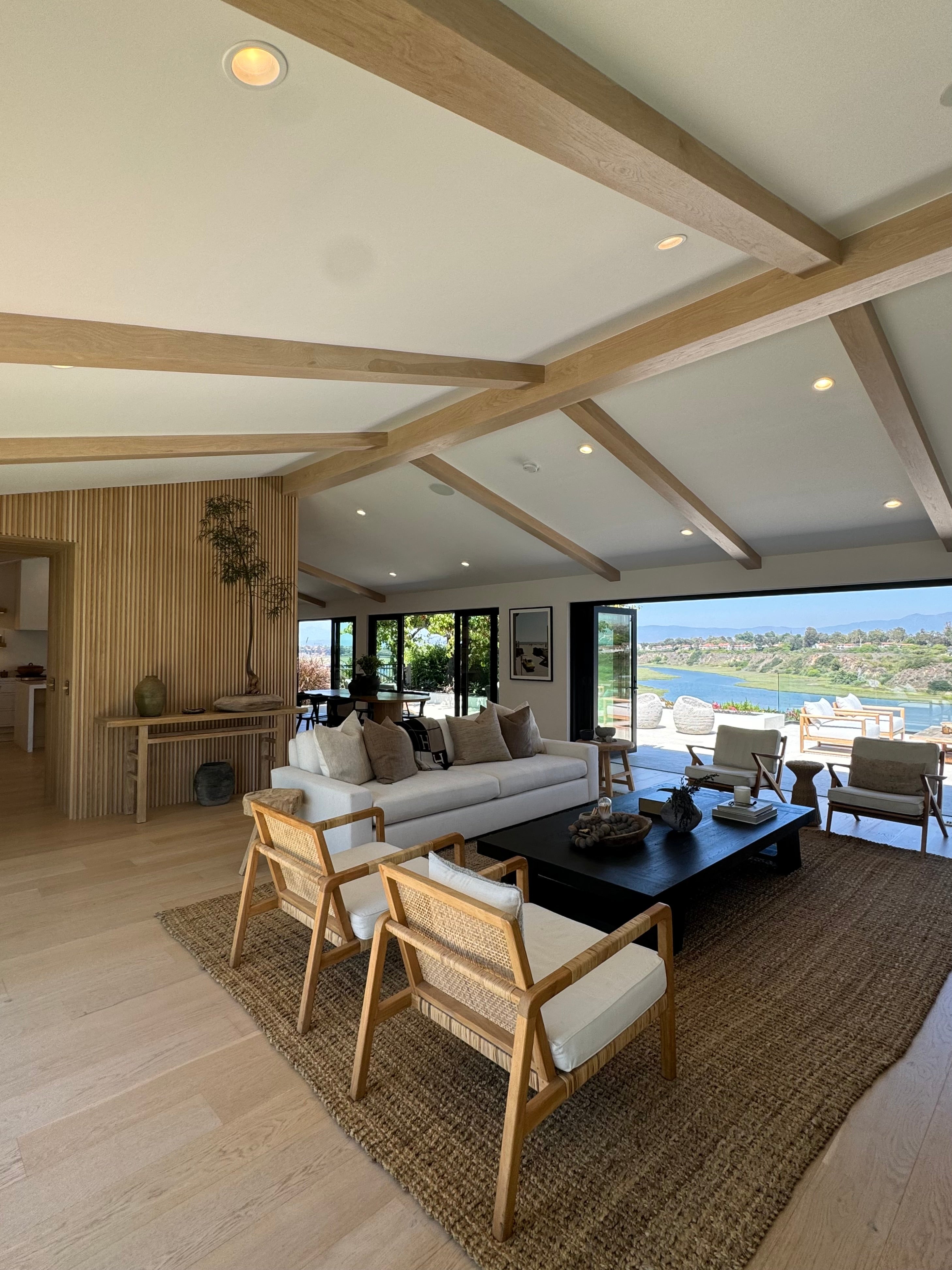
This living room renovation focuses on reconfiguring structure to enhance scale, light, and spatial clarity. By raising the ceiling and reworking structural elements, the space is opened up to feel more expansive and balanced. Architectural changes are paired with carefully selected wall treatments, surfaces, and integrated lighting to create a cohesive backdrop for everyday living.
Wall treatments, surface materials, and lighting are selected and coordinated to work with the new structure.

Custom Wall Panels
Wall panels play a key role in shaping the character and proportion of the living room. Panel systems can be customized in material type, panel width, spacing, texture, and finish to respond to ceiling height, wall conditions, and overall architectural rhythm. From wood-based panels to advanced surface systems such as carbon crystal wall panels, materials are selected and configured to create depth, warmth, and a cohesive visual backdrop rather than applied as surface decoration.
Customization may include panel material selection, module dimensions, layout direction, joint detailing, surface texture, and integration with lighting or adjacent architectural elements.

Floor Materials
Floor materials establish the visual foundation of the living room. Wood flooring, engineered planks, stone tiles, or large-format surfaces are selected based on tone, texture, and overall design direction.
Material customization may include plank width, board length, finish type (matte, brushed, wire-brushed, or smooth), stain tone, and installation pattern such as straight lay or herringbone. Transitions to adjacent spaces, stair landings, and wall panels are carefully coordinated to maintain visual continuity and proportion.
The goal is to create a flooring system that supports the architectural character of the space while remaining durable and adaptable to daily use.
Customization may include custom stain matching, plank dimension selection, edge detailing, threshold integration, and coordination with staircase and wall finishes.

Fireplace Design
Fireplace design often involves more than surface finishes. In many living room renovations, the fireplace wall is reworked to accommodate new proportions, updated ventilation, and integrated storage or display. Firebox size, surround depth, material thickness, and mounting height are adjusted based on the room’s scale and how the space is used.
Structural framing, material backing, and heat-clearance requirements are carefully coordinated before finishes are applied, allowing stone, panel systems, or plaster surfaces to be installed cleanly and safely as part of the redesigned wall.
Design considerations may include firebox sizing, wall framing adjustments, venting requirements, material backing, and finish transitions.

Staircase Design
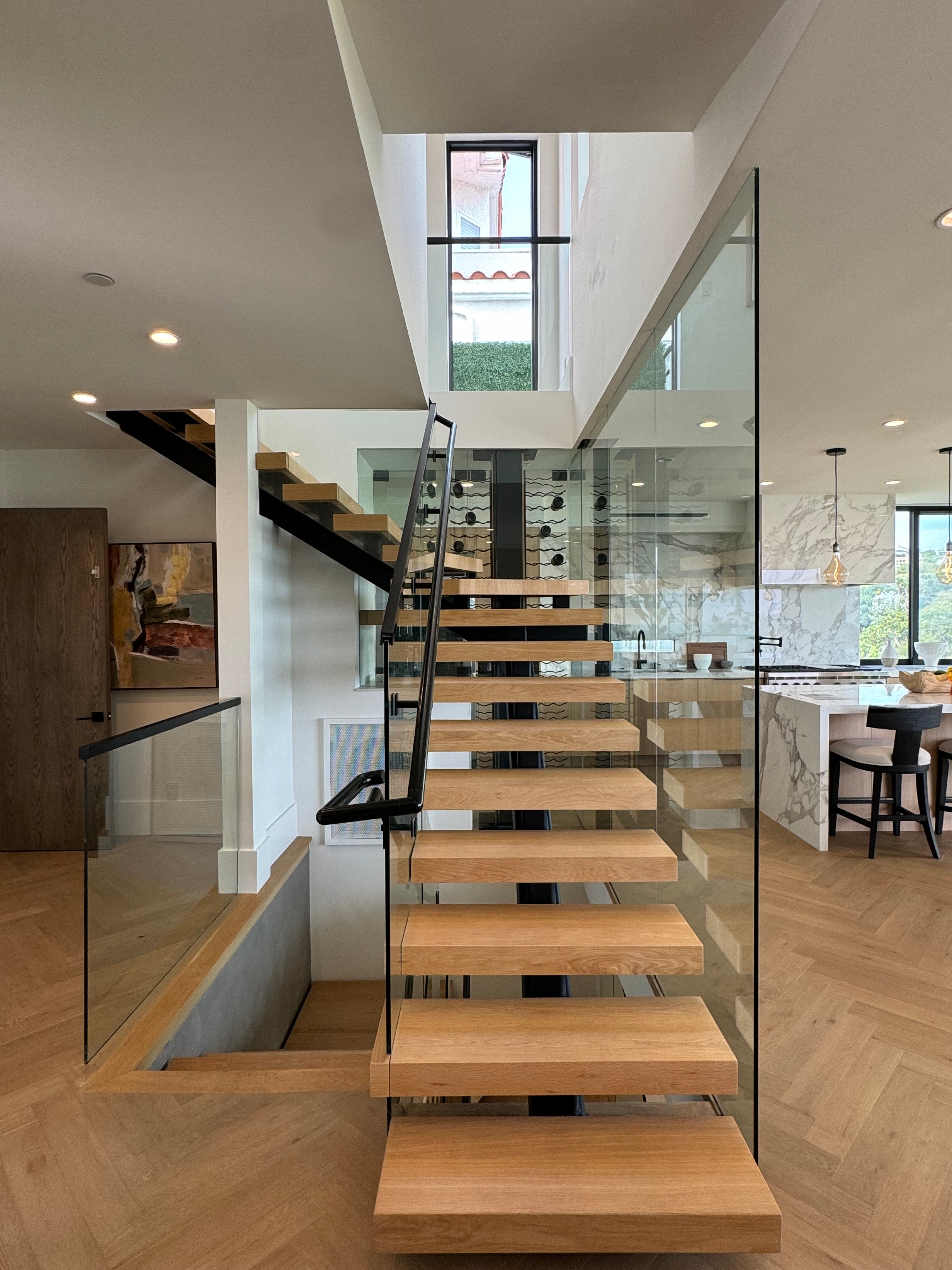
This floating staircase is designed with cantilevered treads supported by concealed structural elements. By eliminating traditional risers and visible framing, the staircase maintains openness and allows light to pass through the space. Tread thickness, spacing, and structural support are engineered to meet code requirements while achieving a clean, weightless appearance.
Glass guardrails and minimal handrail detailing provide safety without interrupting sightlines, allowing the staircase to function as both a circulation element and a defining architectural feature.

Living Room Lighting
Lighting in the living room is designed as an architectural layer rather than a standalone fixture. Linear lighting, recessed channels, and concealed LED strips are integrated within ceilings, wall panels, and structural elements to emphasize proportion and depth.
Linear lighting systems can be customized in length, placement, beam spread, and color temperature to enhance wall textures, highlight material transitions, and define spatial boundaries. Fixture finishes and trim details are coordinated with surrounding materials to maintain a clean, uninterrupted visual flow.
Customization may include integrated linear channels, concealed cove lighting, dimming systems, smart controls, fixture finish coordination, and alignment with ceiling and wall detailing.
Living Room · Design & Material FAQ
Can living room ceilings be raised or restructured?
Can living room ceilings be raised or restructured?
Yes. Ceiling height can often be increased depending on the existing roof structure and framing conditions. Structural evaluation is required to determine feasibility, after which framing, insulation, and finish materials are coordinated to achieve the desired spatial effect.
Can wall panels be customized to fit different room sizes?
Can wall panels be customized to fit different room sizes?
Yes. Panel dimensions, spacing, material type, and finish can be adjusted based on ceiling height, wall length, and overall design direction to maintain balanced proportions.
Can a staircase be converted into a floating staircase?
Can a staircase be converted into a floating staircase?
Depending on structural conditions, enclosed staircases can often be reconfigured into open or floating designs. Structural reinforcement and code compliance are evaluated before design development.
Can lighting be integrated into ceilings or wall panels?
Can lighting be integrated into ceilings or wall panels?
Yes. Linear lighting channels, recessed fixtures, and concealed LED systems can be integrated into ceilings and panel systems to enhance depth and architectural definition.